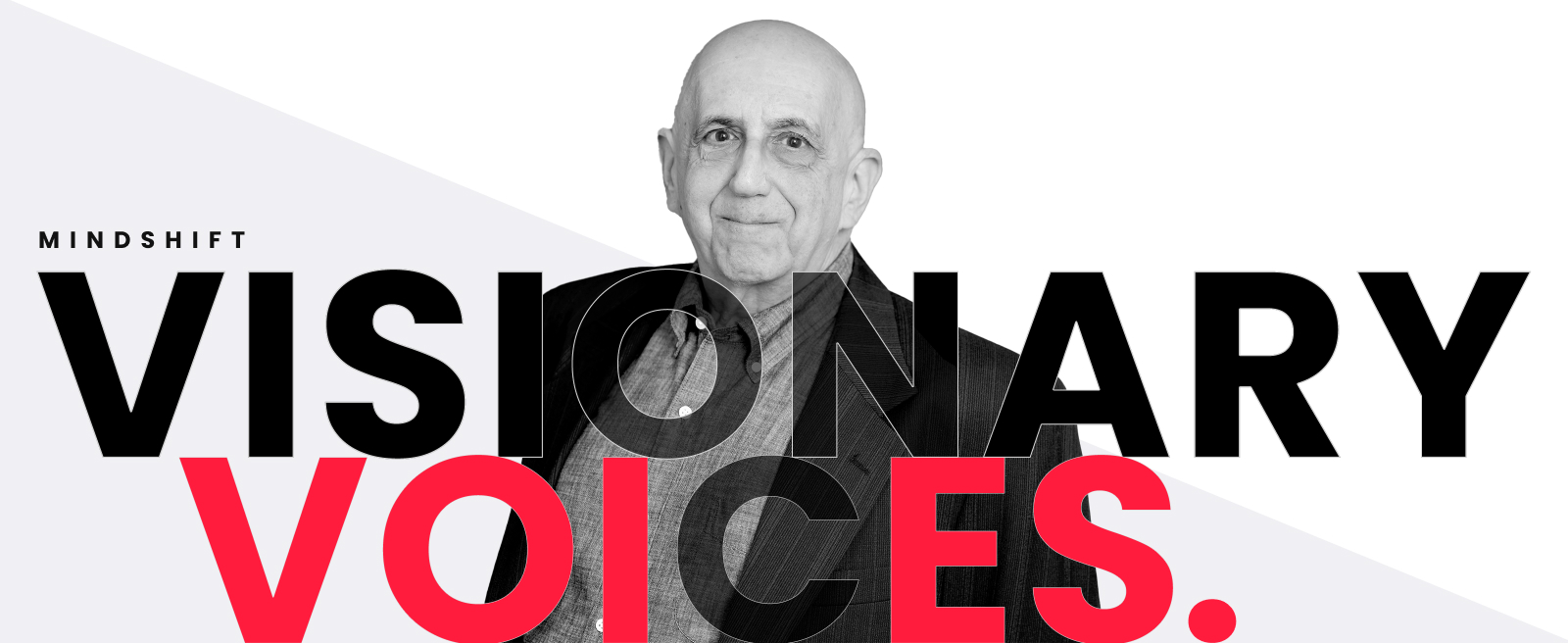
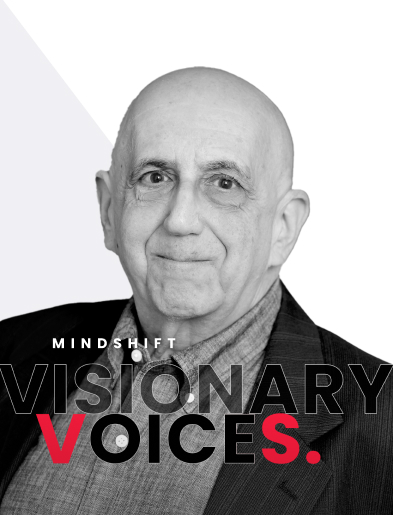
Art Kleiner is a writer, editor, and entrepreneur focused on business strategy, organizational learning, and responsible AI. He is Principal and Editor-in-Chief of Kleiner Powell International (KPI), a content strategy and consulting firm, and a faculty member at New York University. As longtime Editor-in-Chief of strategy+business, he shaped one of the most influential management publications of its era, publishing leading thinkers across strategy, leadership, and organizational change. His most recent book, The AI Dilemma: 7 Principles for Responsible Technology (2023), offers a framework for leaders navigating the risks and opportunities of AI.
We sat down with Art to discuss how AI is triggering a mass awakening of human metacognition: we are learning to think about how we think. Art maps the cultural earthquakes already underway and the ones leaders haven’t even begun to rehearse. His ultimate provocation: stop asking what AI will do to us and start asking what we will do with the extraordinary power it places in our hands.
Art, you’ve argued that AI’s most profound impact may not be technological but developmental. How do you think AI will change what it means to grow as a human being?
Many people are naturally adopting a form of metacognition as they interact with large language models. We are thinking about the way we think. We humans will train the models to train ourselves to be better thinkers. We will do this because it’s easy to do, and because the prompts that do this are easy to replicate.
Most of us haven’t yet realized the way in which these models will affect us, because we haven’t factored in three trends. First, the models themselves are getting more accurate, faster, and capable of more sophisticated word combinations. Second, the ancillary technologies have yet to kick in broadly. For instance, within a few years, AI systems with video tracking will routinely be used like video mirrors, to correct our posture and movement. Third, people are just beginning to share prompts and strategies for using AI.
The combination of more powerful models, increased ease of access and use, and fiercer competition among humans will accelerate all our ability to use the systems. We won’t stop using them, because the feeling of power and control they give us is so compelling. We’re still at the point where most people don’t know how to use the systems productively, but that will rapidly change. It’s a lot like being at the dawn of the age of home computers, when we were wondering whether we’d use them to store recipes. Now we have ersatz oracles in our phones, and we are still learning to ask the right questions and give the right commands.
The greatest payoff is the same payoff you get from a high-quality college education. You become more capable. We will learn to use AI to accelerate our own improvement, and that capability will spread. We have not yet learned to live in a world where most people can do most anything.
Many organizations are racing to deploy AI for productivity gains. What are the most important questions leaders should be asking before they automate anything?
What does this work produce that someone wants?
Has anyone done anything like this before? What did they learn?
In this project, what are we missing? What haven’t we thought of?
Be the people affected by this system. What will it do to you? What do you want it to avoid doing to you? What do you want to tell the developers?
When it fails, how will we know? What will be the early indicators of success or failure?
Who will be accountable?
Whose data trained it, and would they recognize themselves in the result?
What is the infrastructure needed? Joe Ziska, a student of technology cycles, suggests that AI is still at the “scaling phase:” building out its underlying technology. It is not yet at the abundance phase, where people use it routinely as they do the internet today. That’s because we still don’t have the platforms and standards in place that will make it reliable.
And the question outsiders can’t successfully ask, because the answer is proprietary: How do all these questions get incorporated into the way it is designed and used?
You have spent much of your career studying learning organizations. What does a truly learning organization look like in an age when machines can learn alongside humans?
As defined by Peter Senge and Arie de Geus, a learning organization is not one that accumulates information. It was one where people reflected collaboratively and turned their considerations into improved action.
Douglas Engelbart, who coined the phrase “augmenting human intelligence,” foresaw the use of AI to improve human learning. We’re starting to see that use of AI spreading out now, with serious implications – for example, for data misuse and privacy.
Already, organizations are capturing meeting notes and analyzing emails. HR systems already exist that use this data to evaluate people. They will prove to be highly effective predictors of human behavior and individual capabilities.
A learning organization in this era uses the machine to surface patterns – in customer and employee behavior – that no human would catch. It keeps what George Roth and I once called a learning history — an honest shared account of what actually happened and why, not the sanitized version.
We can learn a great deal about human and organizational behavior this way. We can learn a great deal about our own potential for growth. But then who controls the learning that occurs? Will it be available to decision makers throughout the organization? Or relegated to just a few people? Or banned entirely for privacy reasons and to avoid exploitation?
In terms of organizational design: I buy Dave Sulek’s concept of the human stack: that organizations will shift their hierarchies to resemble the stack structure of internet governance. Functional roles will no longer matter as much. AI will handle the functions of IT, HR, Finance, and so on. Employees will be hired and promoted based on our capacity to learn and pivot.
Trust has become a central issue in both leadership and AI. What are the conditions required for trust to emerge between people, institutions, and increasingly intelligent systems?
Years ago I wrote about Karen Stephenson’s work on social networks, which I’d boil down to this: trust doesn’t live in institutions, it lives in networks — in specific relationships among specific people, the hubs and gatekeepers who play roles in the dissemination of information. Four things have to be present for trust to form. Reciprocity: I can rely on you and you on me. Competence: We know and respect one another’s capabilities and can generally count on good outcomes. Safety: We can be exposed to each other without being exploited. And repair: when trust breaks — and it always breaks — there’s a way to rebuild it.
Now extend that to intelligent systems. We tend to ask whether people trust AI, as if trust were an on-off switch. The more appropriate question is what would make a system trustworthy. I’d name the same four conditions. Reciprocity becomes explainability. We can see how the AI reached its conclusion (and it helps us understand the implications. Competence becomes accuracy: we know we can rely on the information provided, or at least we are told when it is unreliable. Safety becomes Risk thinking: We are assured that the AI systems will not exploit or take advantage of us, because the models are designed with guardrails that work. And Reliability becomes Accountability and Recourse. A specific human answers for the outcomes, and the person on the receiving end can contest the result and reach someone able to change it.
Unfortunately, we only become aware of trust problems after the betrayal. We therefore need super-accountable open systems, where the rules of the game are evident to all. The best example we have so far is Wikipedia.
What is the biggest misconception executives currently have about the relationship between human judgment and artificial intelligence?
That today’s technology is the AI we should react to. That AI is standing still.
Language models are evolving so quickly, that the techniques I taught for using and understanding them in Spring 2026 are already obsolete. I think it’s predetermined that the technology is evolving to a point where it will be barely recognizable. Sensors, interfaces, robotics, biotech, and other nascent technologies are just beginning their AI-driven evolution.
Perhaps the most immediate threshold will be the one in which software development is an ordinary way of life for millions of people. Your desktop environment and mine will look completely different, because we’ve each used AI to design our own. Like all software environments, nobody’s AI systems will work completely. But we won’t care.
I’m not too concerned about AI becoming sentient, or artificial general intelligence taking over the world. I just think the world will be too pluralistic. Even if the platforms are consolidated, enough people will choose software-based empowerment that the world will be reasonably chaotic.
But there are still many unknown unknowns about AI. There isn’t much to learn about a technology from the fears people already have. People feared that airplanes would drop out of the sky. They didn’t fear that airplanes would spread viruses.
So we need to be imagining what humans will do with this power, not what AI will do to us.
You’ve written extensively about scenario planning and preparing for uncertainty. What future scenario related to AI do you believe leaders are least prepared for today?
Leaders have rehearsed two AI scenarios thoroughly. One is AI-as-tool: it makes us faster, we capture the productivity, life goes on. The other is AI-as-competitor: it takes the jobs, and we have to manage the disruption.
The scenario I haven’t seen rehearsed much is AI-as-environment — where the ground underneath us shifts and everything inanimate becomes animated. We are heading for a world that resembles Who Framed Roger Rabbit: an exhausting environment of human-made animated systems that seem lifelike and infiltrate urban reality. I’m pretty sure this is predetermined; that is, I cannot imagine a scenario (short of nuclear war or complete economic collapse) where it doesn’t happen within about 10 years.
Already, we can no longer easily tell what’s true, who produced what, or which institutions to believe. My current research with Joe Ziska is on cycles of truth: every time a communication technology moves from scarcity to abundance — writing, printing, broadcast, the internet — societies lose their shared ability to tell truth from noise for a while, then rebuild it. We’re in one of those ruptures now.
If AI becomes extraordinarily good at providing answers, how do we preserve the human capacity to ask better questions?
When inexpensive mirrors were first manufactured, it changed the way people viewed their appearance. When printing made knowledge abundant, it changed the access people had to culture. It took time for our discernment to catch up—the capacity to judge what was worth seeing or worth knowing.
Answers are cheap now. The question that frames a problem correctly is not. So the task is to protect question-asking the way you’d protect any scarce resource. Practically, that means a few things. Resist the reflex to convert every question into a prompt; sit with it first. Use the machine to interrogate your question rather than to skip past it — make it tell you what you’re assuming, what you’re not asking, where the framing is weak. And in how we train people, stop rewarding the fast right answer and start rewarding the better question.
The most transformative technologies often reshape culture before they reshape business models. What cultural shifts are you watching most closely right now?
The first is the renegotiation of where authority over truth lives. For most of the modern era we outsourced that to institutions — newspapers, universities, courts, the credential. We still don’t know what will replace them. All we know is that people crave a source of truth. They will go to great lengths to be assured that some things are certain.
The second is the changing meaning of effort and craft. Watch how people talk about “doing the work.” We’re entering a period where the visible reward for work – a paycheck or a credential – may no longer be as meaningful. When the extrinsic value of competence changes, status reorganizes around something new. It isn’t clear yet what that will be. It will probably be different in different parts of society.
Looking across your work—from The Age of Heretics to your recent thinking on AI—what qualities do the most effective change agents consistently share?
The Age of Heretics was about people inside organizations who saw something the institution refused to see, and remained in place. They didn’t exit, and they weren’t silent. They were loyal to the truth they saw, and loyal to the institution too, which is why they stayed inside and absorbed the discomfort. The successful ones could tolerate being disbelieved for a long time without turning bitter or strident, which is just as hard as it sounds. The truly successful change agents could make their ideas seem reasonable to the orthodox. A heresy that can’t be translated into the institution’s own language moves outside and becomes apostasy.
One interesting question is whether AI favors change agents. It favors insights from a wider range of sources, but it also judges ideas based on whether they have found favor in the past. Unless you ask for heresy (with prompts like, “tell me what I’m missing,”) you probably will just get orthodoxy and groupthink.
Imagine we’re having this conversation ten years from now. What would have to happen for you to say that humanity handled the AI transition wisely?
I’d want to see three things, and they’re all hard to imagine coming true.
First, that humanity rebuilds trust faster than past epistemic ruptures did. After printing, it took Europe more than a century and a few wars to develop the norms and institutions — the free press, evidentiary standards, eventually peer review — that let people share a sense of truth again. If we do the equivalent in a decade rather than a century, that’s wisdom.
Second, that we kept the infrastructure of AI open rather than enclosed. There’s a tension between open standards and a world where a handful of firms own the means by which everyone thinks. The wise path keeps it open, the way we eventually kept the web open. This will require universally accepted standards—and ultimately an evolution of our system of justice.
Third, and most personal: that ordinary people come out of this with the wisdom and mutual commitment to use their power constructively. AI is going to require us to rise to the challenge of our shared humanity. If you have a list of enemies or competitors, you’re already part of the problem.