search

Technologies

  • ServiceNow
  • SharePoint

Industries

  • Healthcare

This global healthcare company was struggling to manage the vast number of applications their scientists used in their critical research. Despite efforts to improve accessibility, applications remained difficult to find and false starts brought about skepticism and a lack of trust.

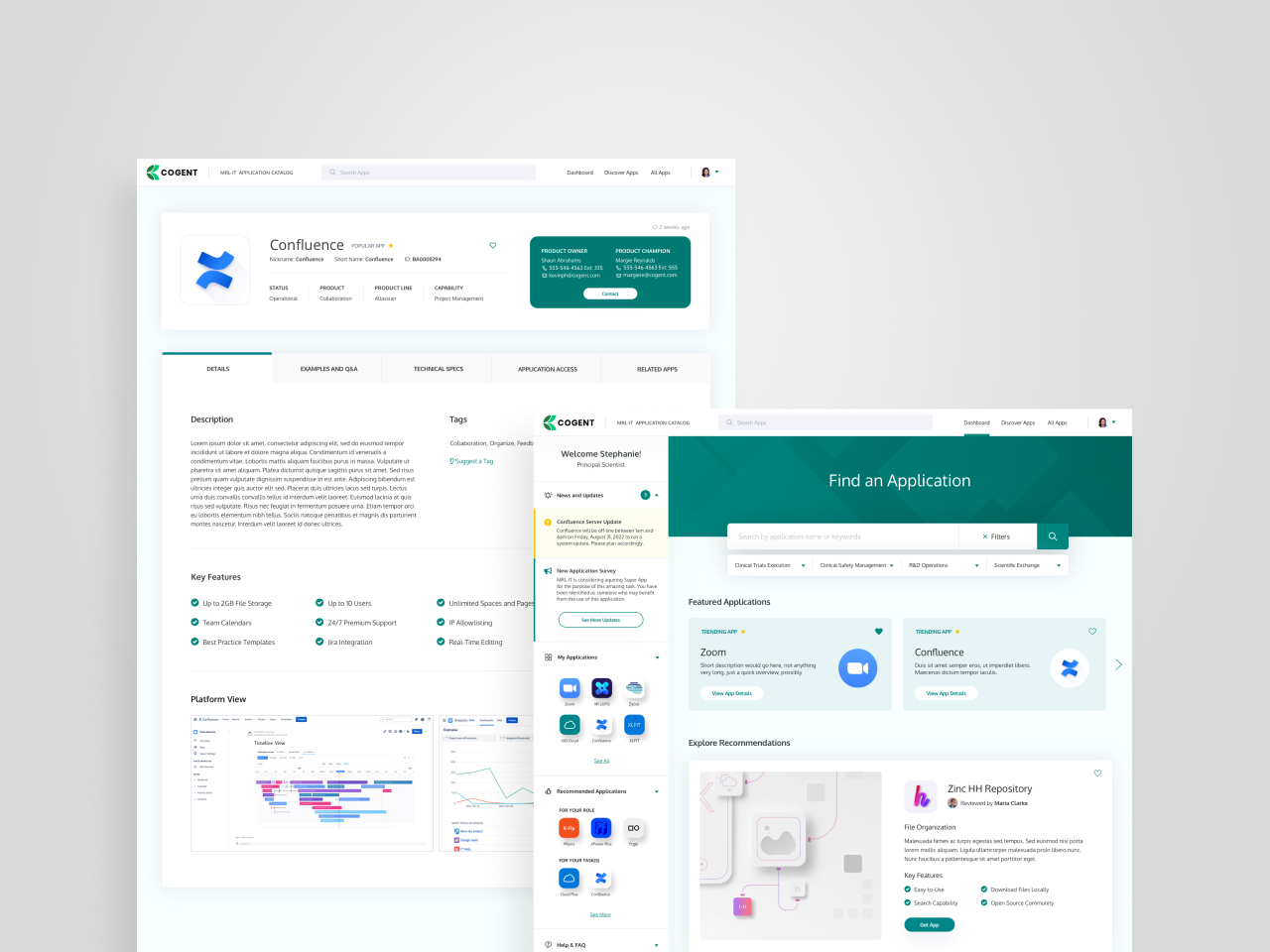
To bring about change users could be excited by, RGP created an experience built to surface mountains of applications into a single searchable location. Influenced by user journeys and discovery workshops, our catalog design strategically targeted the explicit concerns of users and IT managers alike, prioritizing their people, intentionally coordinating chaos and delivering an improved overall experience; so, scientists could focus on critical research rather than application overload.

RGP designed a transformative, exploratory product catalog, integrating 6k+ applications to inspire scientific research.

Prioritizing People, Perceptions and Attitudes

Through discovery workshops, RGP mapped the employee experience journey and identified four personas that needed application information support. Additional empathy maps for all personas provided insight for a prioritized list of features and planted a seed of excitement and anticipation in an audience weary of false starts.

Coordinating Chaos

With 6000+ applications company wide, reducing the number of competing repositories and implementing a robust search mechanism was essential to making it easy for scientists to find the right information at the right time. RGP defined an organizational taxonomy, content examples and a taxonomy playbook to document best practices and standards moving forward.

From Native Knowledge to Exploratory Product Catalog

Although our client worked hard to provide their research teams with boundless applications and tools (6k+ applications), researchers had no easy way to find them. RGP leveraged insights from discovery workshops and persona development to reimagine product delivery and transform a less-than-thrilling product catalog concept to a tailored, exploratory experience. Through a taxonomy of relevant categories, multidimensional filters and hyper-personalized recommendation features, researchers could now effortlessly (and addictively) browse and explore essential applications to empower research capabilities and innovation through one source of truth—eliminating the need to track down information through an unreliable game of telephone.

Designing for Change

RGP conducted 13 usability sessions with research scientists and managers to gather feedback on behavior and attitude across four design variations. The result? A modern UI and prototype that focused users on the task of finding specific applications and discovering new applications.
Privacy Preference Center
RGP logo

When you visit any website, it may store or retrieve information on your browser, mostly in the form of cookies. This information might be about you, your preferences or your device and is mostly used to make the site work as you expect it to. The information does not usually directly identify you, but it can give you a more personalized web experience. Because we respect your right to privacy, you can choose not to allow some types of cookies. Click on the different category headings to find out more and change your default settings.

Strictly Necessary Cookies

Strictly Necessary Cookie should be enabled at all times so that we can save your preferences for cookie settings.

Functional Cookies

These cookies enable the website to provide enhanced functionality and personalization. They may be set by us or by third party providers whose services we have added to our pages. If you do not allow these cookies then some or all of these services may not function properly.

Performance Cookies

These cookies allow us to count visits and traffic sources so we can measure and improve the performance of our site. They help us to know which pages are the most and least popular and see how visitors move around the site. All information these cookies collect is aggregated and therefore anonymous. If you do not allow these cookies we will not know when you have visited our site, and will not be able to monitor its performance.