

contributors

Christina Giglio
Senior Vice President, Revenue

Steve Valestro
Regional Vice President, Revenue

Amadally Hosseinbukus
Managing Director, Data, Analytics & AI, RGP

Stephen Hook
Senior Managing Director, Consulting Digital Solutions

Jennifer Garcia
Managing Director, Finance Transformation

Richard Toledo
Managing Director, Risk & Compliance
November 6, 2026 • 7 Min Read
An insurance CFO described how he had to cut several large transformation projects for 2027 that the company’s private equity owner wanted to keep.
The transformation initiatives were all valid, but the organization was stretched too thin. The CFO described narrowing the work around what the company needed to accomplish over the coming year and not take on anything longer term, despite pressure from key stakeholders, including the private equity owner, whose projects would have to wait.
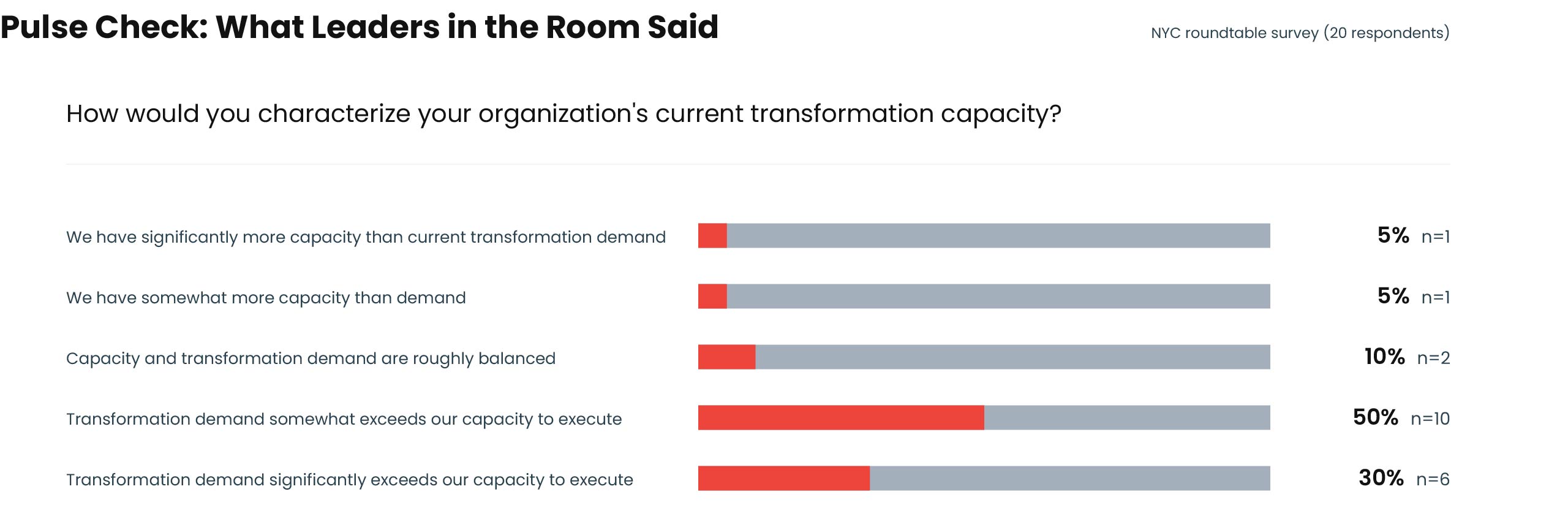
Discussion of this type of capacity problem ran through an RGP-hosted executive roundtable in New York City. Participants described organizations with access to technology and funding for investment, but too little capacity to turn those commitments into results.
RGP’s research involving 400 CFOs and finance transformation leaders underscored the problem: roughly half reported that their transformation agendas exceeded their capacity to execute. In a poll conducted in the room that night, the CFOs’ answers mirrored the research findings. For these leaders, approving another investment could mean adding another demand on teams that are already overburdened.
AI is making this capacity constraint more urgent. Expectations for returns are rising but delivering them requires time and expertise across the business. CFOs face a difficult question: How much more can the organization take on, and what must change to make delivery possible?
As expectations for AI rise, CFOs have to decide what their teams can realistically deliver and who has the authority to keep the work moving across functions.
A Lack of Cohesion
A manufacturing executive described an effort to narrow the company’s transformation efforts. With demands on cash and limited resources, the business was concentrating on operational productivity and the processes supporting its key products. A focused sprint helped identify improvements in coordination among stakeholders, along with opportunities to make better use of available resources.
He said leaders must establish how much work their teams can realistically deliver alongside their daily responsibilities. And then they must create the coordination needed to get that work done, he added. Even a smaller portfolio can stall when no one can resolve conflicts across the business, when there is no unified understanding of what is being taken on and the end goals.
One discussion leader illustrated the problem through a kitchen renovation. The contractors had been vetted and the design was ready. But plumbing, electrical and carpentry requirements collided, creating delays and rework.
“Every trades person did their job, but no one was coordinating.”
Finance, technology, HR, legal and compliance can each meet their responsibilities while the overall initiative falls behind. Dependencies surface late. Decisions move between teams. Rework consumes time the organization can ill afford. Adding more people to individual workstreams may achieve little if no one can resolve the problems between them.
There needs to be a single person who has the authority and the budget.
- Roundtable Participant
Building the Foundations to Use AI
The discussion moved to another demand on teams: preparing the business to use technology that is already available. One executive described a smaller consumer business with AI capabilities available but legacy processes that made the underlying information difficult to organize and use. Another discussed the continuing work of bringing databases together into a usable foundation.
An AI tool may be ready to perform a task before the company can provide the information it requires. Organizing that information takes people who understand the business and have time to work through the underlying processes.
One participant pushed the discussion beyond infrastructure. Did finance teams themselves understand data well enough to recognize problems, judge quality and help redesign how information was managed? Too often, the participant suggested, data readiness was treated as a specialist’s responsibility.
“But actually, I think in this day and time in finance, we do need data literacy as a core capability inside of the function.”
He said finance professionals need to understand where information comes from, how it has been defined and what it can reliably support. Those judgments become more consequential as AI makes it easier to generate analysis and recommendations.
The discussion also challenged the idea that companies must complete a broad data overhaul before getting started.
“There are many use cases you can do in the AI world where you don’t need to solve the whole enterprise’s data problems to be able to get some success,” one contributor said.
Another described the value of choosing a specific application and learning through experience. Using Copilot to draft financial narratives, for example, could give employees a contained opportunity to experiment.
And it also starts to flush out to you where there are deficiencies in your organization and how to prioritize against that.
- Roundtable Participant
Funding Change Management
The roundtable discussion then turned to a capacity requirement that companies often acknowledge but struggle to fund: helping employees change how they work.
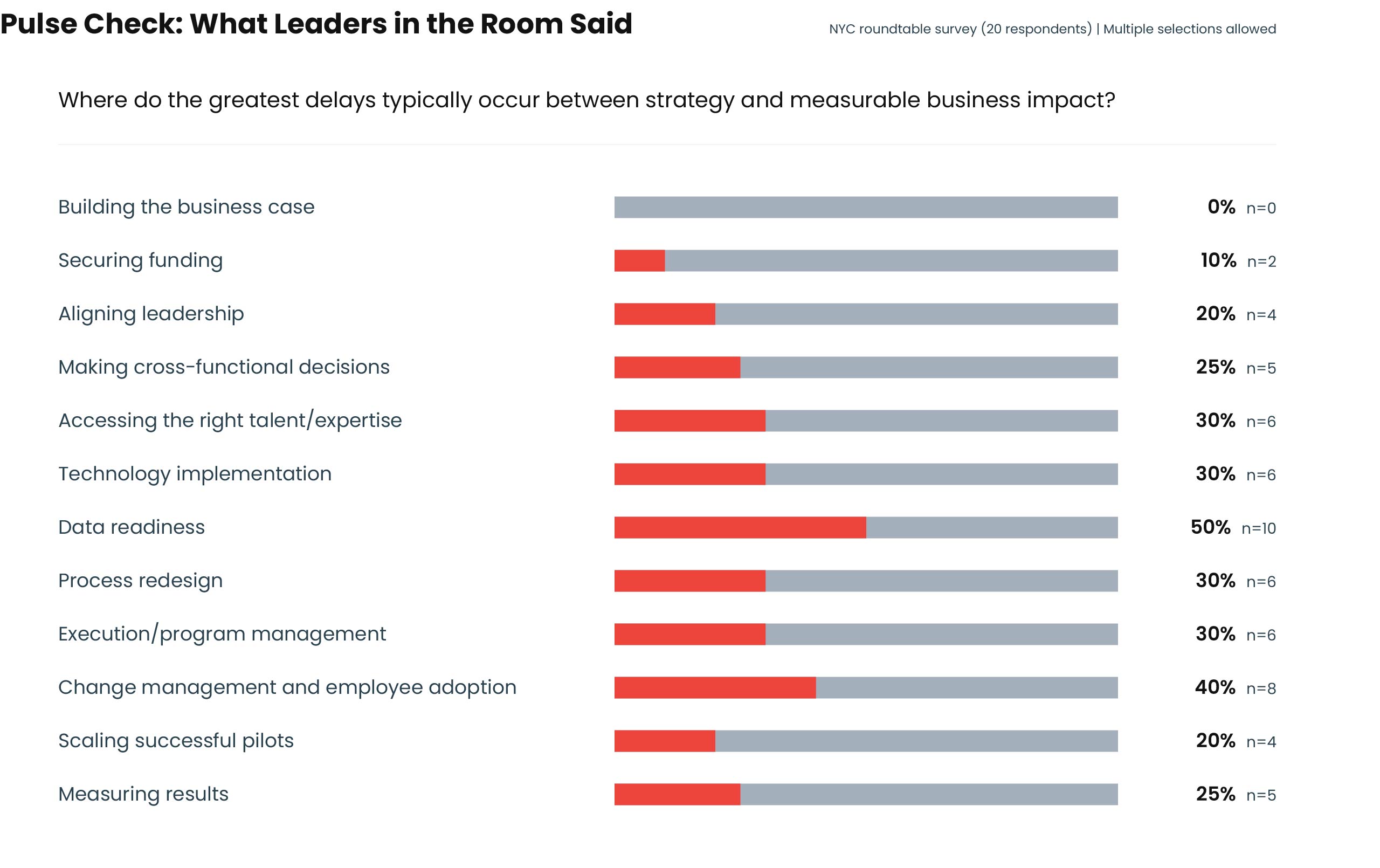
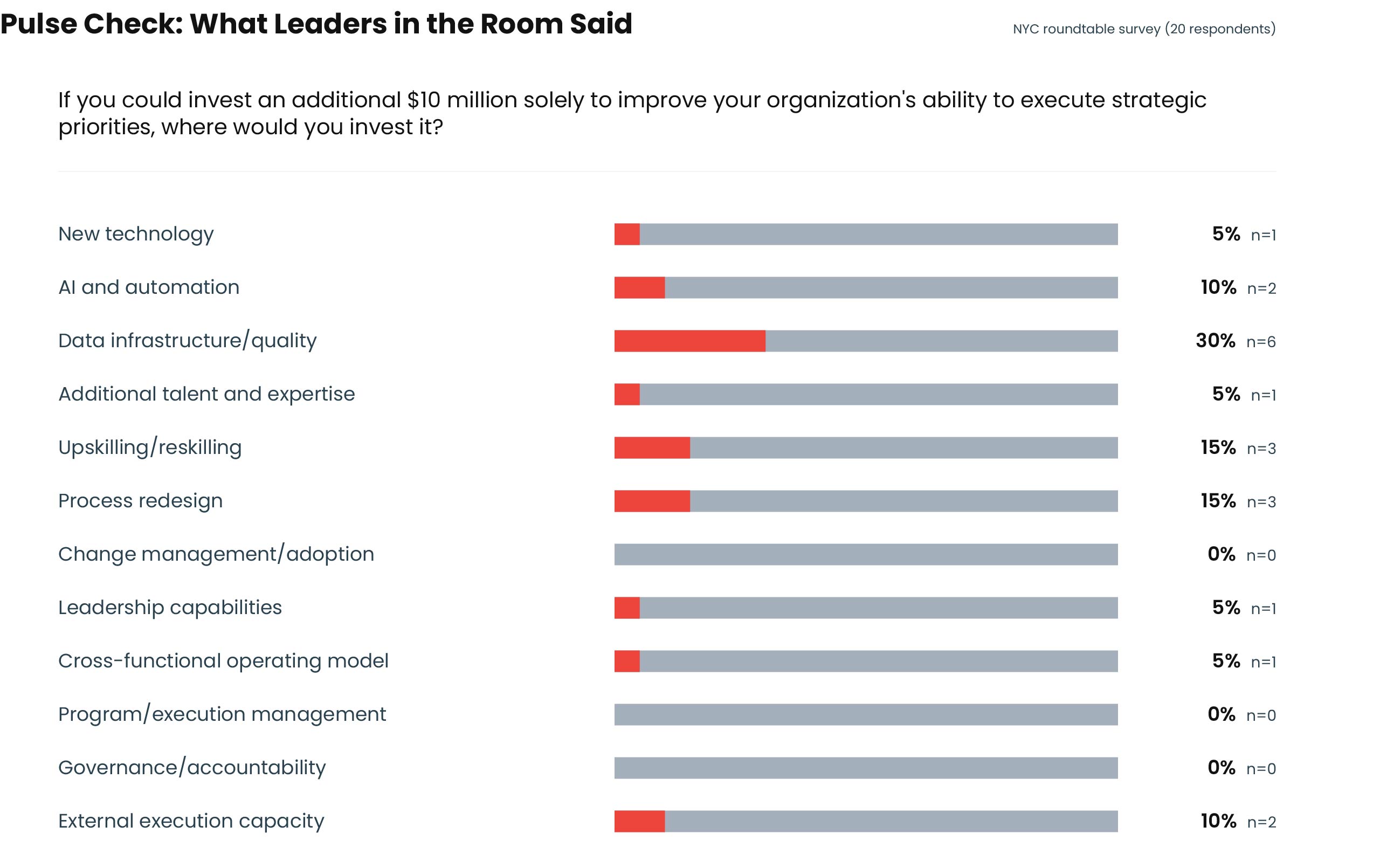
Research presented at the roundtable found that 44% of respondents cited change management and adoption among the leading causes of initiative delays. Yet only 6% would direct an additional $10 million toward that area.
The gap raised a question about whether investment priorities match the obstacles leaders are encountering. Companies are funding new capabilities while giving less priority to the work needed to put them into use.
One executive described asking his C-suite peers to explain where they felt funding for transformation should go. Their answers centered on getting the technology up and working and project management. Changing how the business worked and developing the internal ability to sustain that change were never a part of their funding focus.
Leaders in the room acknowledge that they cannot avoid the adoption and change management work indefinitely. They need to make change management a part of building execution capacity. Employees need to become able to carry the work forward after implementation support ends, with leadership attention and resources extending beyond the launch date.
Actual change needs to be driven by the CFO.
- Bank CFO
As the evening drew to a close, the conversation left CFOs with a challenge to bring back to their organizations: look as closely at the capacity to deliver as at the case for investing. Technology and funding can set transformation in motion, but progress depends on people who have the time, skills and authority to carry it through. For leaders already asking more of stretched teams, the next decision may be which commitments to defer—and where to invest in helping their people take on the work ahead.