

contributors

Jennifer Jones
Chief Strategy & Experience Officer

Jessica Block
Chief AI Officer and Interim Chief Financial Officer

Amadally Hosseinbukus
Managing Director, Data, Analytics & AI, RGP

Greg Derderian
Senior Vice President, CFO Advisory

Rachel Adler
Managing Director, Project & Change Management
November 3, 2026 • 7 Min Read
While headlines warn of disappearing white-collar jobs, the promise of AI in the workplace has never been louder.
From automating workflows to accelerating innovation, the case for AI adoption has largely been made. And in most organizations, adoption is already well underway.
Yet one question remains stubbornly unanswered: Where is the return on AI investment?
That question was at the center of a recent RGP-hosted roundtable in Atlanta, where senior leaders across finance, technology, risk, higher education and business gathered to explore the growing gap between AI’s potential and its measurable value.
Moderated by Jennifer Jones, RGP’s Chief Strategy and Experience Officer, the discussion drew on the firm’s AI x Human research, a survey of 500 professionals actively using AI at work. The findings reveal a striking paradox: 66% expect AI to perform most of their current tasks within five years, yet only 3% feel replaceable. In fact, 94% believe their experience brings value that AI cannot replicate.
Employees recognize that their worth extends beyond the tasks technology can automate. They are betting on judgment, experience, creativity and relationships as the capabilities that will matter most. But whether that confidence is justified depends less on what AI can do and more on what organizations choose to do with the capacity it creates.
The research identifies five tensions shaping that future: the Confidence Debt, the Productivity Tax, the Lost Apprentice, the Executive AI Bubble and the AI Trust Gap. Together, they expose a fundamental challenge: AI may be changing how work gets done faster than organizations are rethinking the work itself.
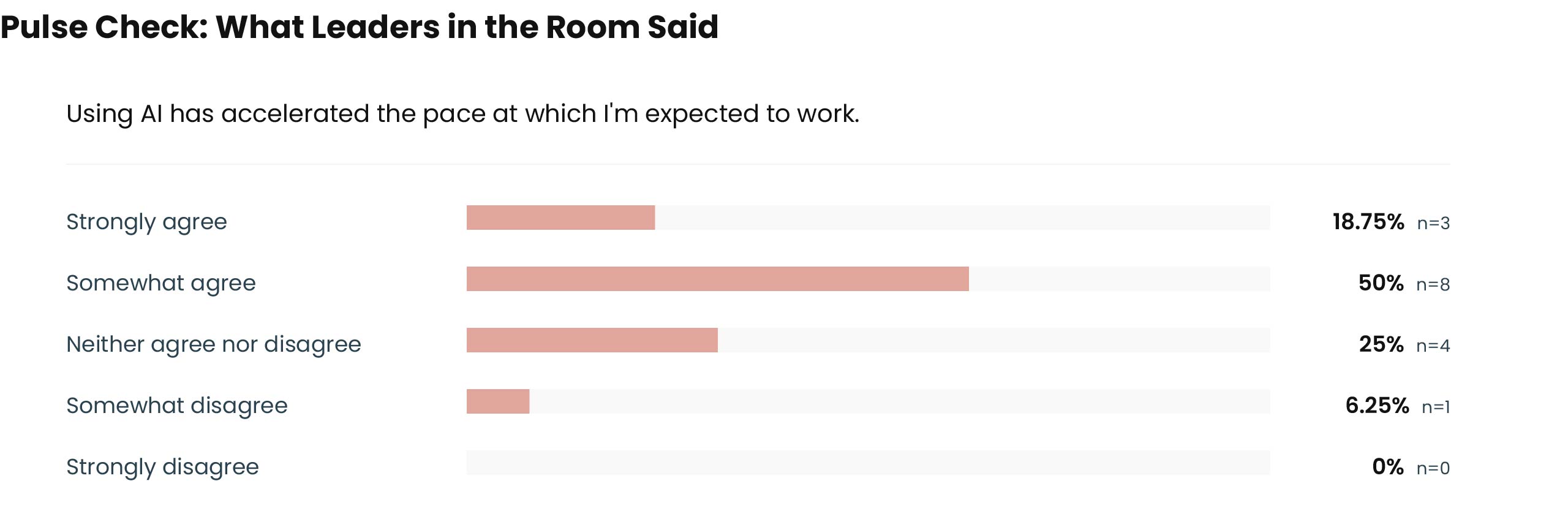
To explore how the room compared with the broader research, attendees participated in a live poll. Their responses echoed many of the study’s findings. Most believed AI could adequately perform less than a quarter of their current tasks, while nearly everyone felt irreplaceable. Eighty-two percent agreed that time saved through AI simply fills up with more work.
Perhaps the most revealing moment came when attendees were asked how confident they would feel reporting AI’s return on investment to their board. Not a single hand went up.
Despite representing organizations at different stages of AI adoption, the leaders shared remarkably similar concerns. Where does the time saved by AI actually go? How do organizations develop the next generation of talent when technology increasingly performs the work through which people once learned? And how do leaders build the trust needed to turn experimentation into lasting change?
Underlying every question was a larger one: If AI is making us more productive, why is it still so difficult to prove that we're creating more value?
Are We Moving Fast Enough, and How Would We Even Know?
“Is your organization moving fast enough with AI to stay competitive over the next three years?” Jones asked. Responses showed that leaders were measuring speed in different ways.
One finance leader, whose company spent six months preparing for a merger, described momentum. Her company established a mandate where AI is the default starting point for every problem. “The first thought is AI,” she said, “and if you can’t solve it by AI, you need to have a good reason for why you can’t.” Those six months have gone into trainings built around AI, education for teams and staff, and working groups. With the merger underway, the pitch to staff has been about capacity: use AI to make room now, so there is capacity to take on more work when the two companies combine.
A second finance leader measured progress through a phased program putting frameworks and infrastructure in place across the organization, backed by a message that has been consistent “all the way from our CEO down into the trenches.” She says the goal is to become an AI-native organization, and the current focus is putting governance in place.
Jones then asked Jessica Block, RGP’s Chief AI Officer and Interim CFO, where a company that feels behind should begin. Block described incremental layers of change. “If everybody hasn’t established foundational, across-the-board access to frontier models in connection with work data, I think that’s a must-have,” she said. Next comes helping people “internalize the intuition around when to lean on the technology,” how to supervise it and how to fold it into their workflows.
“Whatever your starting point,” Block said, “organizations need some way to measure adoption and usage, even if it doesn’t immediately translate into financial results. If you can’t see it, you won’t be able to shift it toward what you want the business to achieve.”
Then Jones asked, “If you had to report AI’s ROI to your board today, how confident would you be?”
One leader said she felt better about reporting the hours saved rather than the dollars, with a caveat. “We can say 40,000 hours saved, but what did we do with it? That’s a hard story to tell.”
We can say 40,000 hours saved, but what did we do with it? That’s a hard story to tell.
-Roundtable Participant, Finance Leader
Am I Thinking About What I Do With the Time AI Gives Back?
Jones first introduced the Confidence Debt. In the report, workers expect AI to do more of their work, yet almost none feel replaceable: 66% expect it to perform most of their tasks within five years, 3% feel replaceable today, and 84% say AI has increased the value they bring to their organization. Jones said the results surprised her because it was overwhelmingly positive.
The report describes that optimism as a bet that, as AI absorbs routine tasks, organizations will keep creating meaningful roles for human judgment and expertise. The debt comes due if organizations don’t.
For one finance transformation leader, that bet comes with caution. “I probably use Copilot at least 50 times a day,” she said. “But am I thinking about what I’m doing, and how much more valuable I’m becoming, with the amount of time that I’m able to save with AI? Those are things we can’t answer just yet.”
The saved time, she explained, doesn’t come back as free time. “I still have to evaluate the data, analyze the data, and make sure it makes sense.” Her approach is ‘trust but verify.’ “While the answers arrive faster, the interpretation, judgment and validation take just as long. I don’t quite trust it, but it does make my tasks a lot easier,” she said.
That evaluation is the judgement workers say sets them apart. One survey respondent described the shift as moving “from producing reports to challenging how much we should trust the answers.”
That evaluation mirrored the room’s own poll. Eighty-two percent agreed that the time AI saves fills up with more work. Jones suggested much of this reflects where most organizations sit on the maturity curve. It’s hard to say you’ve gained 20% more time, and harder still to know what to convert it into, when you’re still validating whether the tools work.
More work sometimes just means more work, and it doesn’t mean measurable ROI.
-Jennifer Jones, Chief Strategy and Experience Officer, RGP
If the Agent Takes the Task, What Happens to the Role?
A leader in higher education shared how the introduction of a custom AI tool initially raised concerns among research staff, but those concerns were manageable. The arrival of agentic AI changed that. “Their fear of job replacement hit the roof,” she said. “We basically said we don’t know what the future holds, because none of us do.”
Specificity eased the anxiety. An agent can take on tasks within a job description, she explained, but it isn’t filling the full purpose of the role. People are still needed to make the critical calls. “You will be responsible for what that agent does, I explained to them. You make the last call. You’ll be accountable.” The university is also building its tools in-house which she said helps improve buy-in.
Still, if an agent can take on a whole workflow, one business leader asked, what happens to people just entering the workforce? “Gone are the days of those normal, lower-level tasks. Now we need entry-level individuals to think more critically.” The attendee turned the question to the higher education leader. “What are you thinking about for your curriculum? How are we making sure that when you graduate, you know how to think strategically and work with AI. Because those are the entry-level jobs now.”
“We have AI task forces with different responsibilities,” she said. “One team is focused on what happens in the classroom. The second team looks at research. Everybody’s working on it, because we know it’s our responsibility.” The same work is happening inside the institution for training staff.
Why Isn’t More Work the Same as ROI?
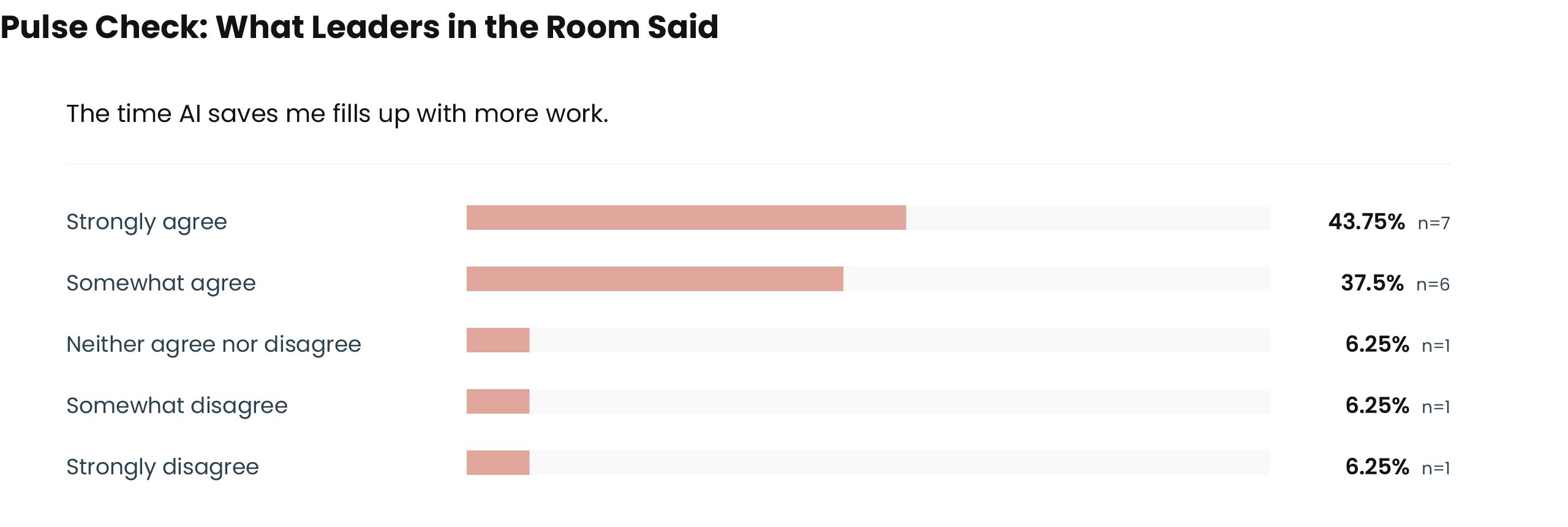
To give more insight on the Productivity Tax tension, Jones shared a figure from RGP’s recent research with 400 global CFOs and 400 global CIOs and CTOs: leaders expect it will take 24 months before they can show the board measurable AI returns. Meanwhile, 73% of workers in the AI x Human research say they’re getting more done, 80% say saved time fills with more work and 82% say the pace expected of them has accelerated. “More work sometimes just means more work,” Jones said, “and it doesn’t mean measurable ROI.”
A technology leader in attendance couldn’t agree more. “Is that growth then? Is it just maintaining a competitive advantage?” he asked. “Is the return in threat and risk reduction, or in faster decisions that lead to tighter client relationships? How is any of it quantified? Does anybody in the room feel like they are able to quantify it yet?”
A business leader answered first. “Well, no we’re not. That time saved on emails won’t be what moves the needle. The returns will come from targeted use cases, “he said, “like portfolio managers and traders getting faster research, and better research results that drive faster decision-making, which gets better products to clients sooner. Broad adoption is quickly becoming table stakes. Everybody has Copilot. Everybody has agent builder,” he said. “Is that going to move the needle more than freeing up a couple of hours? What does that translate into?”
An IT audit leader from the banking industry offered another angle. “AI has actually created more work for the bank,” he said. The threat landscape has shifted, forcing the bank to add capacity in areas like threat intelligence and vulnerability management.
“The traditional processes that organizations have for vulnerabilities and patching were not built at this pace, so they’re not sustainable.” Many organizations are patching and keeping up, he mentioned, hoping to move from reactive to proactive. But AI is also creating new skills and roles. Preparing the next generation is its own race, he added. “You go to bed, and you wake up in the morning and this technology has advanced twofold. What you were teaching them yesterday is probably no longer valid.”
Is This a Pedagogical Challenge or a Generational Problem?
Jones pointed to an interesting contradiction. In the wake of COVID, many CEOs called employees back to the office, citing the importance of mentorship and learning from more experienced colleagues. Yet the research suggests proximity alone isn’t enough. Younger workers are increasingly turning to AI before seeking guidance from colleagues, while senior leaders are doing the opposite. The risk is that AI may be quietly replacing the very interactions through which the next generation develops judgment, experience and expertise.
The danger is not that AI gives early-career workers the wrong answer. It’s that it gives them a perfectly good one and removes the reason to ask another human who explains why, challenges assumptions, and sometimes disagrees with the premise. “We solved proximity,” the report concludes. “Now we have to solve for apprenticeship.”
Larissa Conley, RGP’s Senior Vice President of Human Resources, says organizations should think about redesigning what people do and the value they bring. She’s worried about future entry-level workers developing their own sense of judgement. She’s worried about the Lost Apprentice tension.
“I get concerned that the next generation could lose out on some of those valuable skills that we all learned from our craft, which was learning by mistakes and taking chances,” she said. “Gaining experience is all about having discussions with your colleagues and your managers.”
Her answer revealed a prominent concern attendees shared: The current workforce has experience they can bet on when making judgement calls about AI’s output, but newcomers will have to develop judgement some other way.
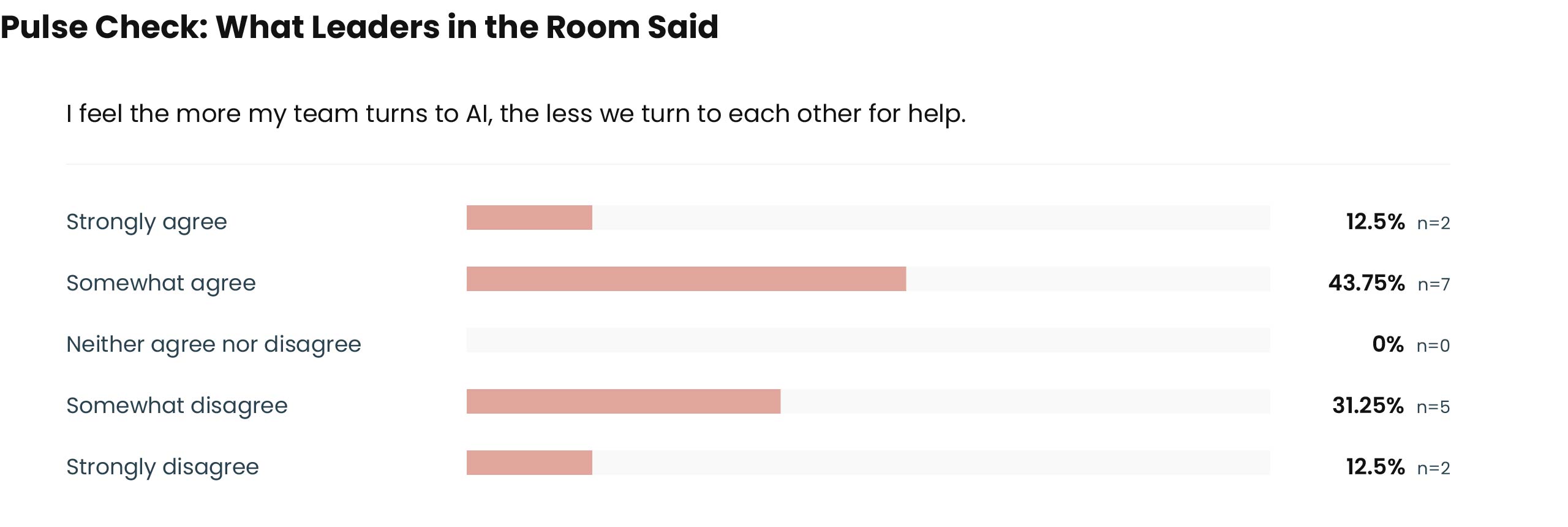
The research gives Conley’s concern weight, too. Fifty-one percent of Gen Z respondents turn to AI first, even for complex problems, compared with 7% of C-suite executives. The room’s poll points to a potential loss of connection: 56% agreed that the more their team turns to AI, the less they turn to each other.
The remedy, Conley suggests, starts with how managers are trained and, through them, the workforce. “People need to be very transparent about using AI in the workplace, having conversations about how they use prompts and interpret what they get back so that we’re not losing the skill of exchange with our peers.”
We solved proximity. Now we have to solve for apprenticeship.
-RGP AI x Human Research
When discussing how one finance professional in the survey worried that early-career workers are “losing opportunities to build strong accounting skills through hands-on work,” learning the answer rather than learn how to get there, the room did not agree on how to resolve it.
Block called it a pedagogical challenge. “Development is no longer a linear progression through exposure to different circumstances,” she said. She learned most things through reverse engineering and hopes others can do the same. “The way I learned code was seeing something that worked and being able to rip it apart and figure out why it worked.” AI offers a new version of that, she argues, because people can now work backward from countless examples of what good and bad look like. “I don’t bemoan the loss of the drudgery, that work, we all had to do,” she said.
A senior finance leader disagreed. “I have guys now that are two or three years out of college, and they’re super sharp,” he said. “But they go right to AI, and you ask them how they got there, and they can’t explain it.”
The finance transformation leader agreed. “I’m fearful that we are losing a generation of truly understanding why something happened, or why the data is saying something specific,” she said. The next generation, she suspects, will get an answer and turn it in without understanding what they hand over.
Block didn’t dismiss the concern, but she pushed back. “It’s incumbent upon us as leaders to teach people to interrogate, and to teach against this reality.” For this reason, her team built a leadership simulation around supervising AI. “It wasn’t, did you use AI? It was, how did you use AI? What were the inputs? What were the underlying assumptions? Why did you agree or disagree with what came out?” The exercise planted hidden errors, such as a stale cash balance, to see who caught them. “It’s probably on us as supervisors to figure out how to meet people where they are,” she said, “because they’re not just going to do it the long way.” In effect, it put into practice the transparency Conley had called for earlier: asking not whether someone used AI, but how.
One participant offered a sobering counterweight: The path of least resistance will outweigh the risk of being wrong. “Human nature is going to take us down that path,” he said. If there’s no imperative to do the hard work, he asked, how do you get people to do it?
It’s incumbent upon us as leaders to teach people to interrogate, and to teach against this reality.
-Jessica Block, Chief AI Officer and Interim CFO, RGP
Who Decides, and Who is Accountable?
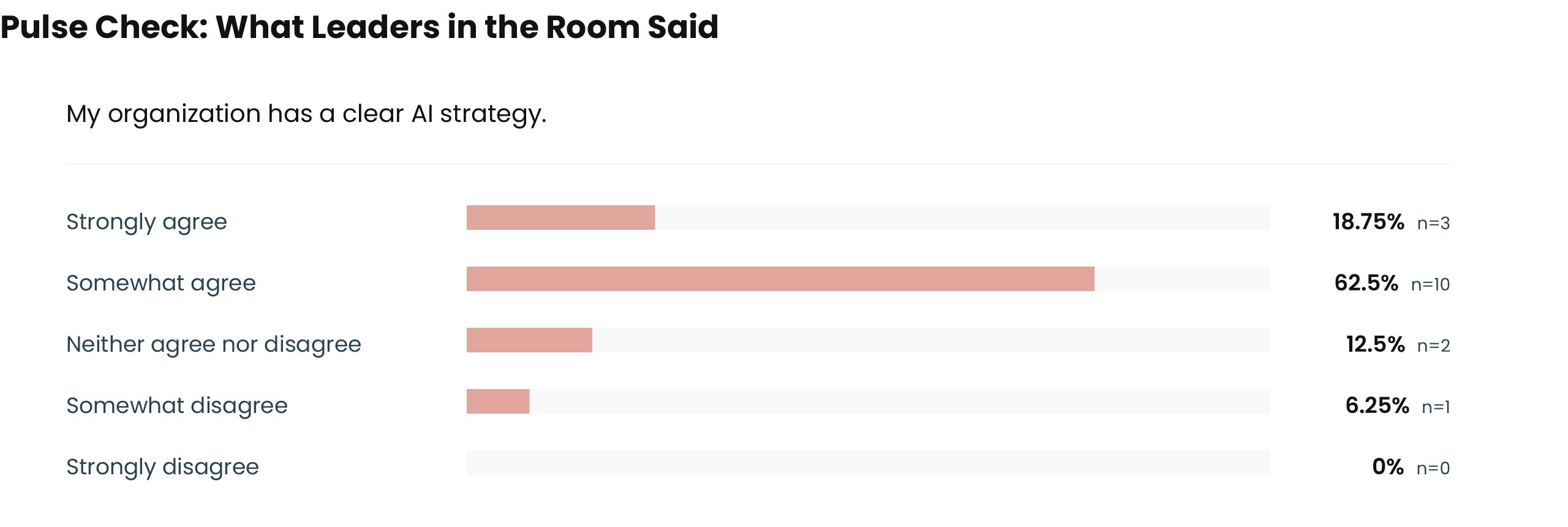
As dinner was served, Jones named the last two tensions. The fourth, the Executive AI Bubble, concerns who decides how AI is used and from what vantage point. In the report, 98% of executives say they have a voice in whether, when, and how AI is used, versus 75% of individual contributors. Yet clarity of strategy thins as it travels down. While 89% overall say their organization has a clear AI strategy, 84% of management understand what it means for their work, compared with 71% of individual contributors. “Are you judging the AI experience in your company only on adoption,” Jones asked, “and not truly what your workers’ experience is? Do they feel safe?”
The fifth was the AI Trust Gap. Sixty-three percent of professionals say they disclose their own AI use, but only 47% believe their colleagues do, and just 55% know when AI informs decisions about them, such as hiring or performance reviews. In the room survey, 38% said they often disclose, 37% sometimes, and 25% rarely. The report found employees remarkably comfortable with AI, with 87% saying they could admit an AI-related mistake without fear of consequences. But comfort is not governance, and Jones pointed to organizations that have faced reputational and financial damage after unchecked AI work reached clients. “Governance is going to be at an individual accountability level versus how we’ve treated enterprise governance in the past,” she said. “And if people aren’t building judgement, they won’t know when disclosure matters or what to disclose.”
Governance is going to be at an individual accountability level versus how we’ve treated enterprise governance in the past.
-Jennifer Jones, Chief Strategy and Experience Officer, RGP
What Works Next
As the evening drew to a close, there was no single answer to resolve the tensions the research surfaced. Leaders shared a common concern about what gets lost when AI is adopted without a plan: time saved that quietly becomes more work, early-career employees who miss opportunities to develop judgment, and decisions made by leaders whose experience with AI differs from that of the people they lead.
Addressing these challenges requires more than adopting new technology. It demands a deliberate rethinking of how work gets done, how people develop, and how organizations measure value. None of this happens overnight. It requires the kind of intentional, sustained work that builds stronger organizations and more capable people.
Perhaps that is the biggest opportunity AI presents. Not simply to do the work we do today faster, but to rethink the work itself and create something more valuable in the process.
The real return on AI may ultimately be measured not by how much work it takes away, but by how much more it makes possible.