
contributors

Jennifer Jones
Chief Strategy & Experience Officer

Scott Rottmann
President, CFO Advisory

Amadally Hosseinbukus
Managing Director, Data, Analytics & AI, RGP

Terry Peters
Managing Director, Brand Experience

Danielle Custalow
Managing Director, Digital Build & Integration

Brett Wells
Managing Director, ERP
October 30, 2026 • 7 Min Read
Senior finance, technology, and business leaders came together in Chicago for an RGP-hosted roundtable on the evolving relationship between AI and human work.
AI is opening up enormous possibilities that would have been hard to imagine even a year ago. Expertise is available in an instant. Problems that once consumed hours or days can be tackled in minutes. Ideas that organizations lacked the time or resources to pursue are suddenly within reach. But as businesses embrace these possibilities, an equally important question is coming into focus: What happens to the human workforce?
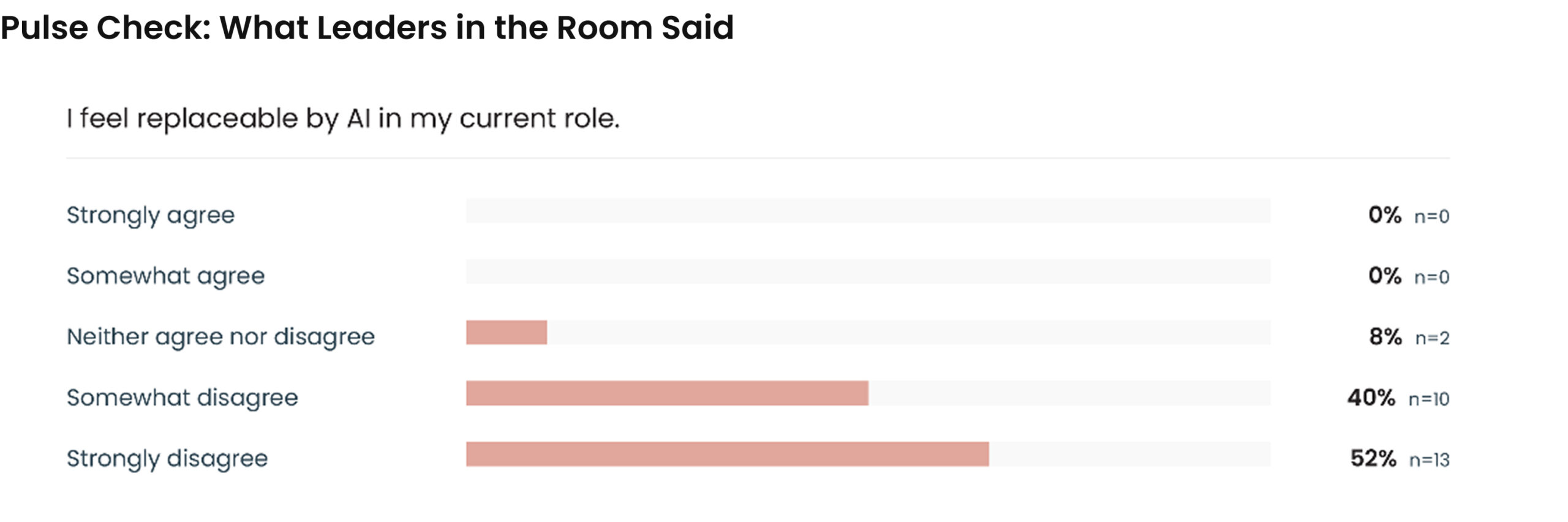
Moderated by Jennifer Jones, RGP’s Chief Strategy and Experience Officer, the discussion drew on the firm’s latest AIxHuman research, a survey of 500 professionals already using AI at work. The findings offer a more hopeful picture than the prevailing narrative of a workforce afraid of being replaced.
The research revealed that employees see a future for themselves in which their unique human contributions of experience, judgment, creativity, and relationships become even more valuable. Some 94% believe their professional experience adds value beyond what AI can provide, even as roughly two-thirds expect the technology to perform most of their current tasks within five years.
Making this future possible will require organizations to think carefully about how work changes and how people can grow with it. When AI frees up time, how should employees use it? What could they accomplish that wasn’t possible before, and what support will they need to take on more demanding work? And how will they develop the judgment that comes from human interaction and experience?
Around the room, executives described different ambitions for AI and different pressures shaping their decisions. There was considerable promise in what they shared, alongside difficult questions with no settled answers.
What became clear is that the choices leaders make now will influence what their businesses can achieve in the future.
What Happens to the People?
One of the evening’s most revealing exchanges came when a technology executive described how his company used AI to transform its human resources function. AI now handles many of the routine questions and transactions that previously required HR personnel, he explained. Employees and managers turn to an automated system for tasks ranging from personnel transfers to routine HR inquiries. AI has reduced HR resource needs by approximately 80%.
Many routine transactions could be handled effectively by AI, he said, but more complicated questions, particularly those involving senior leadership, were another matter.
“It becomes much more challenging in functions that are not as strict as HR,” he explained.
A controller at a consumer goods company offered a strikingly different perspective. With a small finance team, he views AI as a way to manage an increasingly demanding workload. The objective is to free his team from repetitive work and give them more opportunities to contribute across the business in more valuable ways.
We need to use this to keep our lives sane and be able to hit the deadlines that we have. And we need it to be able to reach out and have conversations we have never had before.
-controller, consumer goods company
A transportation leader described how his finance organization is confronting significant operational and accounting challenges with a five-person team. Just six weeks into his role as CFO, he is looking at ways to stabilize operations. He plans to use AI to improve fundamental processes and allow his small team to become more effective.
He recounted spending several hours working on financial reporting, using Microsoft Copilot to make progress on work that previously would have taken substantially longer.
“I’m using it to really make us more consistent and more operationally effective,” he said.
For Terry Peters, who leads RGP’s Brand Experience practice, the danger is that organizations will automate work without reconsidering the role people should play in it. Finishing tasks faster does not necessarily mean producing better outcomes, he argued, especially when AI is layered over poor data or flawed processes.
Read Peters’ Perspective on Designing AI With Humans in the Loop
He drew a comparison to automobile manufacturing. On a traditional assembly line, a worker repeating the same motion can eventually stop noticing what is happening around them. Peters contrasted that with one automotive company’s approach, where workers are empowered to stop the line when something looks wrong. The difference is between mechanically checking a result and taking human responsibility for improving it.
When you’re empowered to add value to the system, you’re accountable and you care about the outcome.
-TERRY PETERS, Managing Director, Brand Experience
In AI-enabled workflows, by contrast, employees can become little more than reviewers of automated output, searching for errors and approving results without exercising their own judgment. Peters warned that this can become a “rubber stamp exercise.”
“We have to design these workflows and these processes around people who are adding value at the center of it,” Peters said. “That means pushing the idea further, challenging the outcome, not just saying, yeah, that looks good or no, it does not.”
More Work, But Where Is the Return?
If AI is producing dramatic efficiency gains, why are so many organizations still struggling to demonstrate a return on their investments?
RGP’s research suggests part of the answer may lie in how companies use the time AI saves. Although 73% of professionals report getting more done, 80% say that the time saved is filled with additional work, while 82% say the pace at which they are expected to work has accelerated.
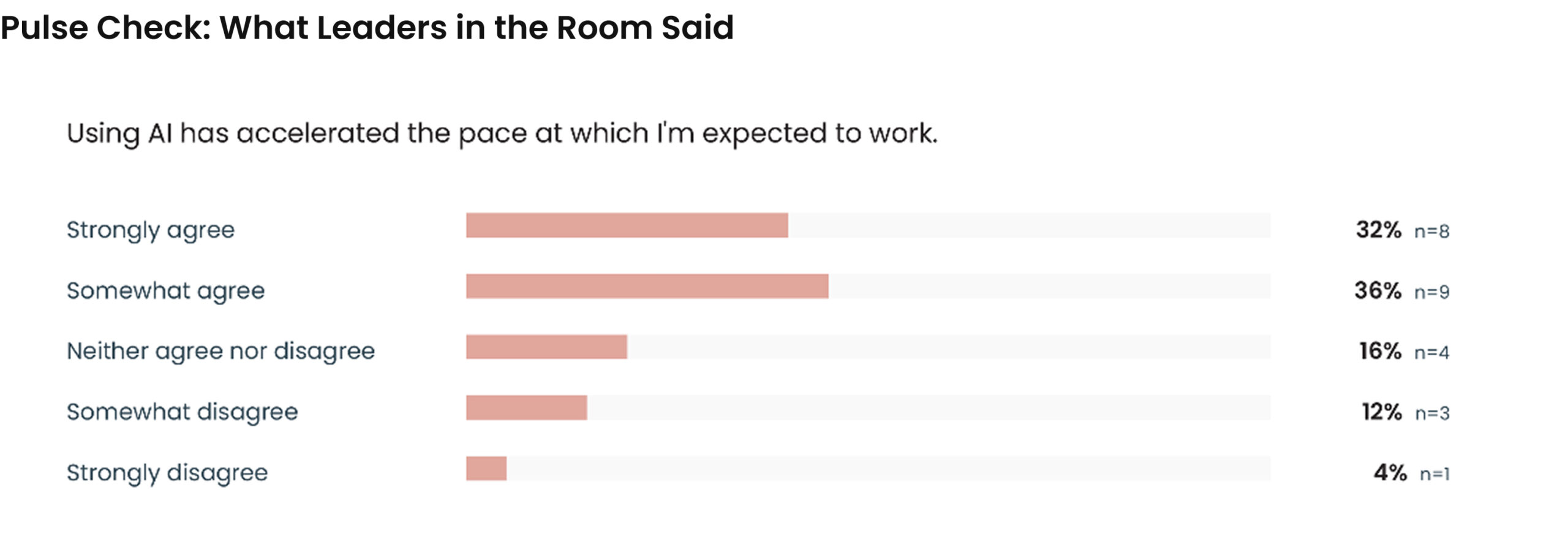
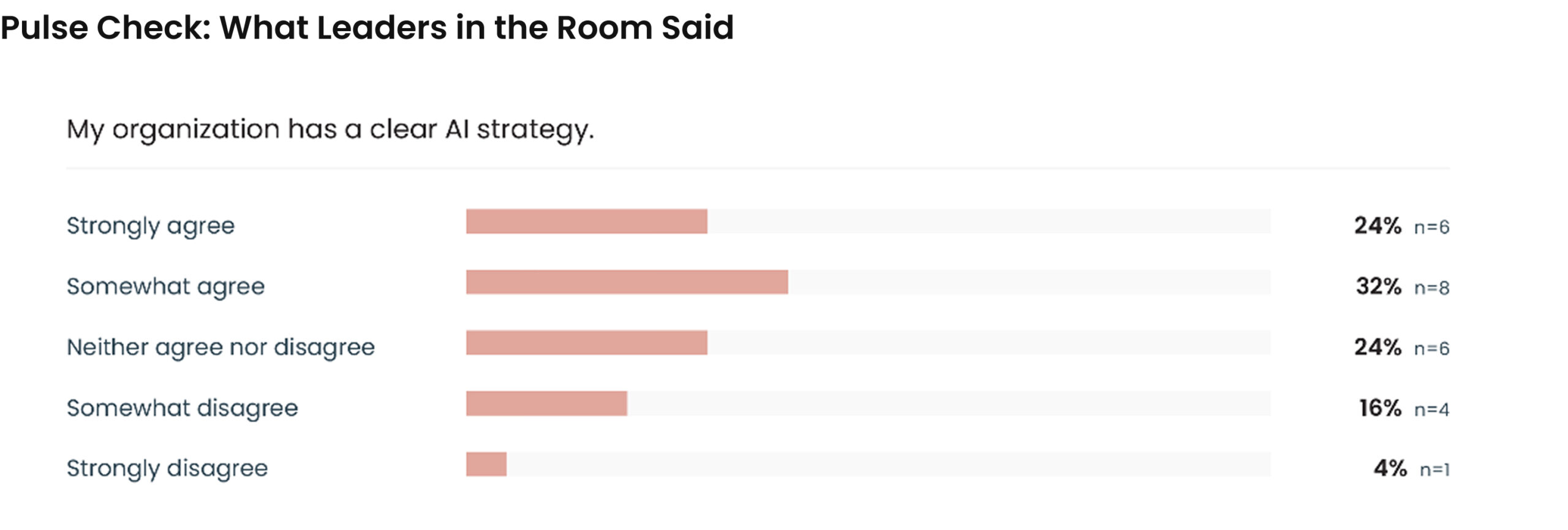
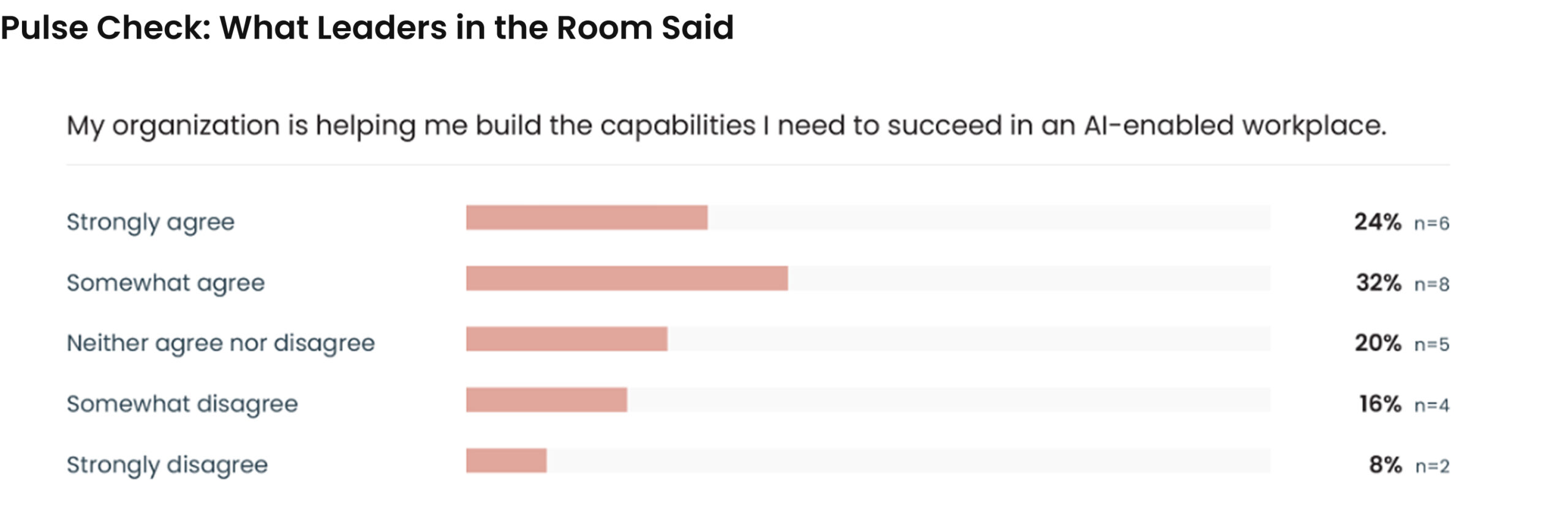
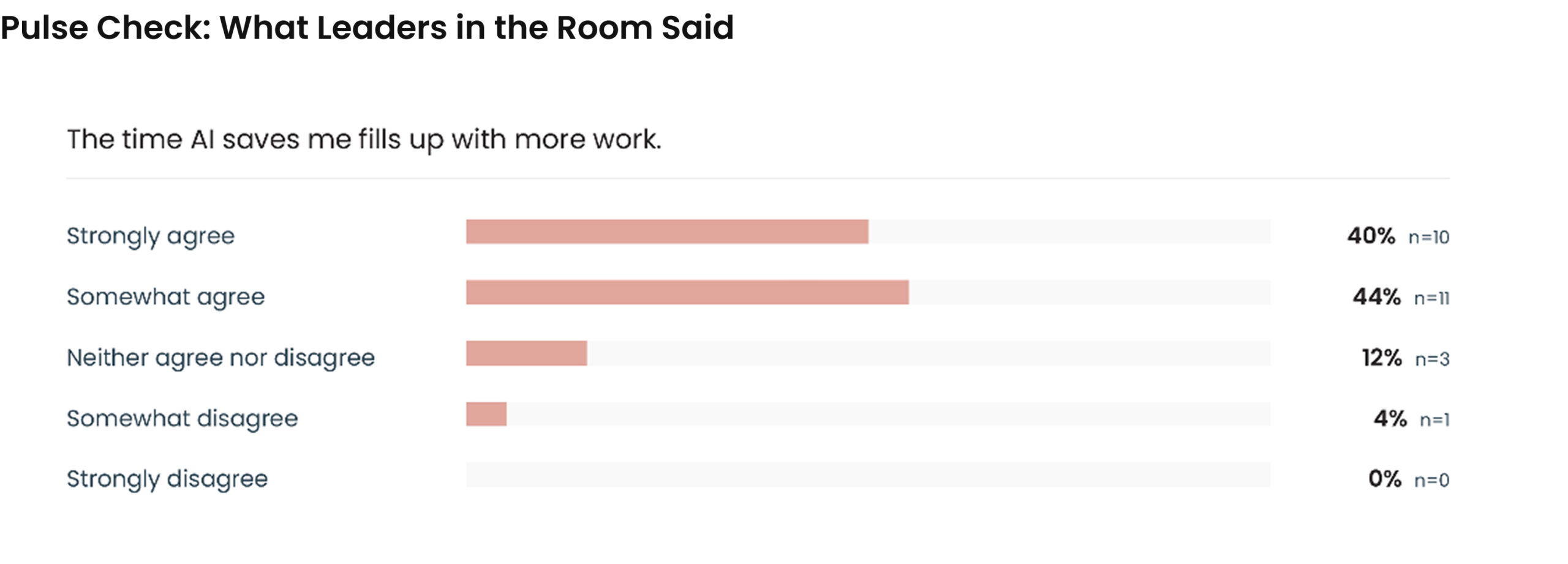
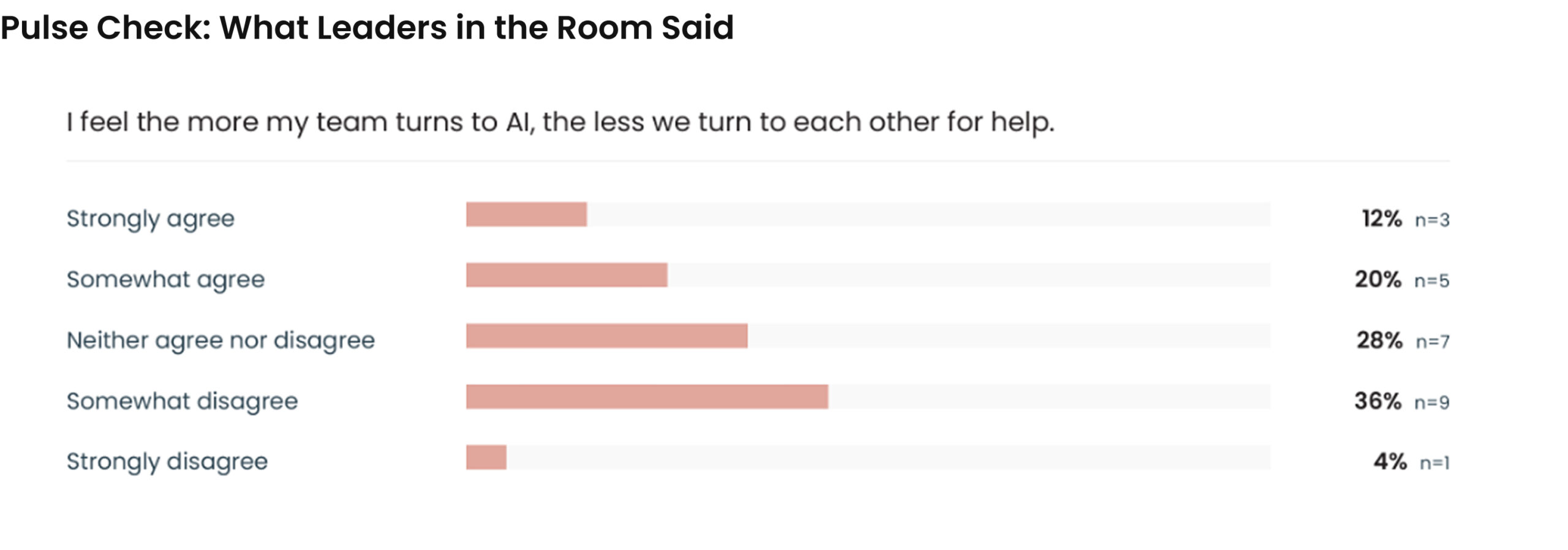
The Chicago participants reported a similar experience. In a short survey conducted during the roundtable, 84% agreed that the time AI saved them was filled with more work.
Jones challenged participants to think about whether their organizations had clearly established what productivity gains were supposed to achieve. If AI returned 20% of an organization’s capacity, she asked, would the business use that time to create new products, improve margins, pursue growth opportunities, or simply demand more output?
Amadally Hosseinbukus, leader of RGP’s Data, Analytics, and AI practice, argued that the most successful organizations are beginning to move beyond using AI solely to automate existing activities. He said these organizations are identifying opportunities that previously were not practical.
“The initial wave was around how best we can improve efficiency and target reductions to some degree,” he said. “Now it’s more about business growth.”
Explore Hosseinbukus’ Perspective on Enterprise AI Readiness
Brett Wells, who leads RGP’s ERP practice, brought the issue into sharper financial focus.
A 20% improvement in capacity, he argued, does not automatically translate into a 20% improvement in ROI. He offered an example of automating 1,000 hours of monthly reconciliation work. The savings might be real, but understanding their value requires knowing what happens next.
“If we’ve saved 1,000 hours because I automate something, where do those hours go?” he asked. “Are costs actually reduced? Does the organization close its books faster? Does reporting become more accurate? Are employees redeployed to activities that support growth?”
The discussion also touched on the emerging practice of measuring AI consumption through tokens, the units used to process information within AI systems. One executive compared evaluating business value through token consumption to measuring the success of an ERP transformation by CPU usage. Understanding the cost of AI is important, but computational activity says little about whether the organization is generating greater value.
The financial leader of a $10 billion food and beverage manufacturing company spoke to the overriding importance of capturing the less immediate benefits of AI, including innovation and product development.
What's being under-measured when it comes to ROI is what organizations are doing that free up the workforce to actually drive innovation and product development. That is where the ROI will become huge.
-FINANCIAL LEADER, Food and beverage manufacturing
For the executives around the room, the implication was clear: Productivity gains are only the beginning of the ROI conversation. The greater challenge is deciding what the organization intends to do with them and how to harness the AIxHuman equation for growth.
Who Will Develop Tomorrow’s Judgment?
One of the evening’s most consequential discussions centered on the skills future leaders may never develop. RGP’s research found that 51% of Gen Z professionals turn to AI first when confronting complex problems, compared with only 7% of C-suite executives.
For younger employees, AI is an increasingly natural source of guidance. But the executives questioned what happens when employees bypass the apprenticeship experience traditionally required to develop sound judgment.
One technology leader described the risk of allowing less experienced developers to rely on AI-generated solutions without understanding their underlying logic. Experienced developers acquire expertise through difficult problems, errors, and corrections, he observed. Those experiences teach them to recognize when something is wrong, even if the answer initially appears convincing.
We need to build that deliberate judgment into the workplace for the early-career folks that we have.
-technology leader
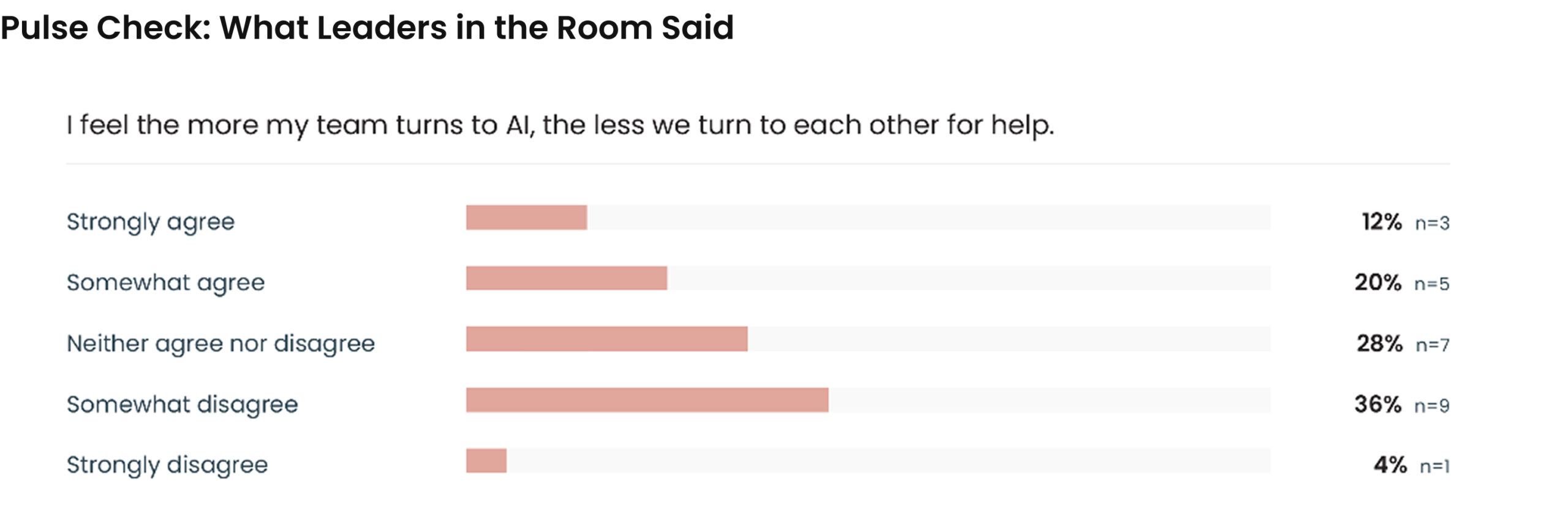
His organization is exploring ways to pair AI-assisted coding with senior developer review, as well as architecture discussions and structured opportunities for junior employees to examine potential failures. Rather than simply accepting an AI-generated solution, junior developers will be asked to explain their choices, identify vulnerabilities, and consider the consequences of their work.
“Why did you design it this way? Where could this fail? How do you know if it failed?” were among the questions the executive wants senior developers to ask of junior team members.
Another finance leader agreed that organizations will need to rethink both the skills they develop and how they develop them.
“The workforce is definitely going to change,” he said. “Organizations must recognize which activities AI can perform and which activities people still need to master. We will increasingly need to have a human workforce capable of recognizing problems and exercising sound judgment.”
Who Is Accountable When AI Gets It Wrong?
As the discussion turned to governance, participants described a familiar tension between encouraging AI innovation and ensuring the technology is used responsibly. RGP’s research found that 63% of professionals say they disclose their own AI use, but only 47% believe their colleagues do. Just 55% say they understand when AI influences decisions that affect them.
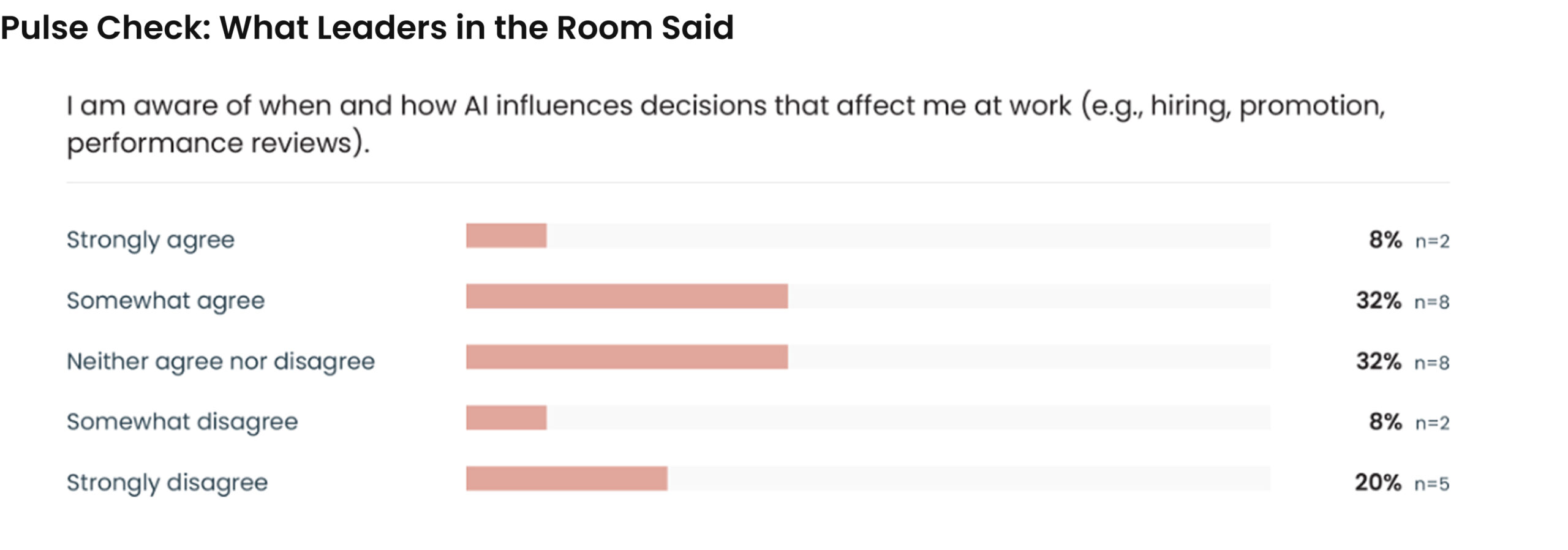
For Jones, those findings underscored the limitations of governance policies. Organizations may have formal guidelines governing AI, but accountability ultimately depends on what happens at a more personal and immediate level, such as when an employee uses AI-generated analysis and then makes a recommendation to a customer.
A telecommunications executive described the governance approach at his company. It began with controlling access to AI tools and protecting company information. The organization initially focused on relatively straightforward uses, such as producing presentations, documents, and communications, before moving toward applications involving enterprise data and analytics. That progression exposed the importance of the underlying data environment.
“As part of our governance initiatives, we cleaned up our data,” he explained, describing efforts to make information more accessible and reliable.
Another transportation executive described how AI agents have been deployed at his organization to monitor data-center infrastructure and then identify early warnings of potential service disruptions. The AI helps engineers determine root causes of problems before customers are affected. The applications offer tangible operational benefits. But, he said, with all that, an audit revealed that some agents had not been properly registered under the organization’s governance procedures.
He said the experience exposed the practical complexity of AI oversight. Even technologies deployed for legitimate business purposes and designed to improve operations need to be monitored and subjected to appropriate controls.
Hosseinbukus emphasized that governance cannot end when an AI application moves into production. Models can change their performance over time, and biases can emerge. Organizations therefore need processes for monitoring how AI behaves after deployment, not simply approving systems before they are introduced.
AI is not a fire-and-forget type of technology.
-Amadally HosseinbukuS, Managing Director, Data, Analytics & AI, RGP
For Peters, the essential question is which decisions should remain with people. He argued that organizations can delegate repeatable, predictable, and verifiable activities to technology. But where decisions involve ambiguity, competing priorities or significant consequences, human judgment remains indispensable.
“The ultimate decision really needs to lie with the human,” Peters said.
Beyond Automation
As the evening drew to a close, the discussion exposed how much remains unresolved in the relationship between AI and humans. The executives in Chicago offered no single answer to the complex tensions that arise in the growing use of AI.
What their discussion made clear, however, is that leaders will have to make consequential choices with incomplete knowledge and will need to remain willing to reconsider them. They will need to examine what is being lost alongside what is being gained. How carefully they make those decisions will shape both the businesses they become and the people within them.
Related Insights