
Share:
Visionary Voices.
Bringing the Numbers to Life.
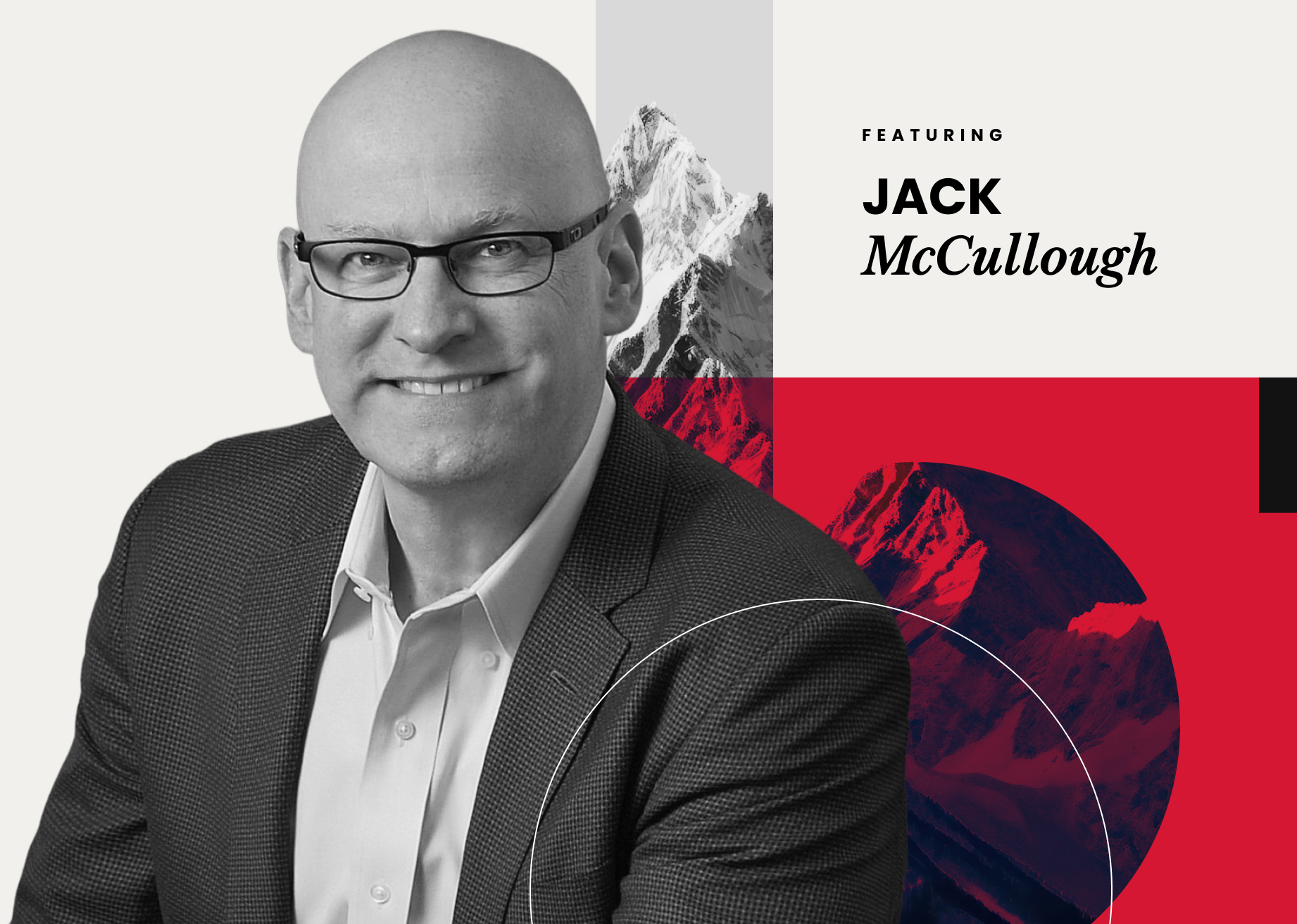

A Conversation with Jack McCullough
Jack McCullough is the founder and president of the CFO Leadership Council, a global community of senior finance executives. A former CFO, author and longtime observer of financial leadership, he has spent two decades helping finance leaders navigate the expanding demands of their profession. He is the author of Secrets of Rockstar CFOs, The Psychopathic CEO and MBA for Lunch, a Forbes contributor and host of the Secrets of Rockstar CFOs podcast.
We sat down with Jack to talk about how the CFO role is changing, why leadership and communication matter as much as financial expertise, and what AI means for the next generation of finance leaders.
You’ve watched the CFO role evolve for decades. What’s the biggest change you’ve seen?
When I was a CFO, and I was a reasonably successful CFO, the job was largely backward-looking. It was financial reporting, cost management and analysis. It wasn’t particularly strategic. When I look at controller job descriptions today, they sound a lot like the job I had that was called CFO. And I’m not that old!
I have a catchphrase that CFOs seem to love: CFOs no longer report history, they make history. And I think that’s really true. CFOs are on the front lines now. They’re helping shape the direction of the company, not just reporting what happened after the fact.
For years, CFOs would say their most important strategic partner was the CEO. But I’m not sure CEOs necessarily reciprocated that feeling. They might have said it was the head of sales or engineering, particularly in a technology company.
That’s changing. More and more CEOs recognize that the CFO is the person they go to. They’re financial experts, but they’re also strategists. And they’re often the people who have to tell the CEO when the emperor has no clothes. The VP of marketing isn’t necessarily going to do that. The CFO has to.
The CFO is also becoming much more involved in technology decisions. How has that relationship changed?
When I was a CFO, my role in technology decisions was to shut my mouth and sign the check. I’m only mildly exaggerating. I was treated well, but I didn’t fool myself into thinking I could second-guess the technology people.
Today, the relationship between the CFO and the CIO or CISO is absolutely critical. Neither is making these decisions in a vacuum. They’re talking constantly. And it’s not just about costs anymore. Back then, if you wanted to sell me on a technology investment, you’d tell me how much money it would save or how much more efficient operations would become.
Now the questions are different. How does technology help the company grow? How does it affect our competitive position? What’s the strategic opportunity? If a CFO can’t understand those things, at least to a reasonable degree, he or she is going to struggle in the role.
As the CFO’s responsibilities expand, is there a danger the job simply becomes too big?
I do worry about that a little bit. When I was a CFO, I had a controller, but I was effectively my own chief accounting officer and my own chief compliance officer. Of course, I worked for smaller companies. Now you’re seeing more specialized roles that support the CFO, which is a good thing. But you do wonder, where does it end? They’re only human, after all.
I’ve heard people describe the CFO as the deputy CEO, and I think there’s something to that. We’re also seeing more CFOs move into CEO roles or take on broader responsibilities within their companies.
It’s an exciting evolution, but the CFO has to be able to lead through other people. You can’t personally be the expert in everything.
You talk about the CFO being a very different kind of leader today. What qualities are companies actually looking for?
I did something recently that I wouldn’t even call a survey. I just reached out to a lot of people I know — CEOs, board members, venture capitalists, other members of the C-suite. I think of them as the CFO’s customers.
I asked a very open-ended question: What are you looking for in a CFO? What traits are most valuable?
What surprised me was that almost none of the answers had anything to do with finance or accounting. They were leadership and personality traits: collaboration, resiliency, empathy, agility, transparency and empowerment.
Empathy! Who would have thought a decade ago that we’d be talking about CFOs being known for their empathy?
Agility was another important one. People want someone who can make decisions, who doesn’t drag their feet. And empowerment is really about being able to lead teams effectively. Of course, CFOs still have to understand finance. That’s a given. But what makes someone exceptional in the role today goes well beyond technical expertise.
One of the things that struck me in our conversation was your emphasis on storytelling. Why is that becoming so important for CFOs?
CFOs themselves can be a little uncomfortable with the word storytelling. But semantics aside, it’s incredibly important. Anybody can say profit margins in Europe are down 3%, they’re up 2% in Latin America and they’re flat in Asia.
Okay, those are some great facts. But what’s the story? Why did we fall in Europe? What are we doing well in Latin America that we might be able to apply elsewhere? Maybe there are factors beyond our control, but even so, what are the implications?
That’s much more valuable than simply regurgitating data that people can look up for themselves.
And I’m not talking about fiction or embellishment or spinning. CFOs stink at spinning, and I think we want them to stink at it. People trust CFOs because they believe they’re going to get the plain, unvarnished truth.
But you don’t appreciate music by reading the notes on a page. You have to bring the music to life. That’s what great CFOs do with financial information. They help people understand what’s really going on and what it means for the business.

AI is changing finance rapidly. Do you find CFOs excited about it, or are they approaching it with some hesitation?
It’s interesting because CFOs were initially accused of dragging their feet a little bit on AI. But their concerns were different from those of, say, a VP of sales or a chief marketing officer. They were thinking about privacy, cybersecurity, controls and governance. These things are critical to the CFO’s responsibilities.
So maybe they were a little more cautious about implementation. But you have to ask whether that caution was actually justified. Governance is a critical part of the job. It’s not sexy, but it matters enormously. At the same time, I think AI is an incredible tool. You can almost think of it as one of your most valuable employees. But you still need somebody who understands the business and can apply human judgment to what the technology produces.
AI isn’t going to outsource judgment. It’s not going to outsource ethics. And it doesn’t inspire trust and confidence the way human beings do. You need someone who can look at an AI-generated analysis and say, ‘Okay, thank you for this analysis, Uncle Claude. But what does this mean in the real world?’
That’s where the real value comes from.
Does AI change what it takes to be an exceptional CFO?
Absolutely. And let me give you a caveat: almost every AI prediction I’ve made over the last two years has turned out to be wrong. I certainly didn’t see everything coming. I could have been so much richer! But I think the important thing is that AI changes what people can accomplish. It doesn’t eliminate the value of exceptional judgment.
Imagine people are on a scale of one to 100 in terms of how good they are at something. AI may raise the capabilities of people at the lower end of that scale. But the people who are truly exceptional, the ones in the 80s and 90s, are still going to be exceptional. They have great business judgment. They’re talented, they’re passionate, and they’re really good at what they do. AI can make them even more effective.
I heard someone make the observation that AI won’t replace CFOs, but CFOs who use AI will replace CFOs who don’t. I think there’s a lot of truth in that. And it’s not an age thing. It’s a mindset thing. The willingness to learn and embrace technology is going to be essential.
You’ve also seen the traditional background of CFOs change. Are companies looking for different kinds of experience?
I think of the modern CFO as being at the intersection of finance, leadership, problem solving and technology. When I became a CFO in the late 1990s, most of us had come through public accounting. And that’s still a perfectly viable path.
But now you’re seeing CFOs with much more varied backgrounds. I’ve interviewed a surprising number of CFOs with engineering degrees. When you think about the CFO as a problem solver, rather than someone who simply reports what happened, it makes sense. Engineers are trained to solve problems.
Economics can also be a great background because it helps you understand broader trends and how they affect the business. The profession is becoming more intellectually diverse, and I think that’s a very good thing. The best CFOs bring different ways of thinking to the table.
You’ve written about individuals whose value to an organization can be far greater than their title suggests. How did you become interested in that?
A CFO who’s a friend of mine told me a story that really got me thinking. He had to make a reduction in force, and he had to choose between keeping his controller and someone with about two years of experience who had a very narrow specialty in generative AI and finance.
He loved his controller. She understood the business, made the trains run on time, was well respected. He thought she was a future CFO. But he kept the specialist.
His reasoning was that he could eventually hire another excellent controller. But there was nobody else on his team with this person’s particular skill set, and he thought it might take a year to replace her. That fascinated me. Here was someone with very limited experience whose contribution had become almost irreplaceable.
It reminded me of an earlier experience helping investors wind down companies. Sometimes the people they kept weren’t the senior executives. They were individuals somewhere in the middle of the organization who had capabilities the business simply couldn’t survive without.
That’s what led me to explore the Rottmann Paradox — the idea that someone’s organizational importance and their actual value aren’t necessarily the same thing.
How should CFOs think about identifying and retaining these people, particularly as they transform the finance function?
It’s difficult because these people often work in the background. A friend of mine was a fire chief, and he gave me a great example. Everyone respects the firefighters who rush into burning buildings. They’re heroic. But there are other people in the department who inspect wiring, test smoke detectors and make sure equipment works. They’re preventing the fires from happening in the first place. How do you recognize a disaster that didn’t happen?
The same thing happens in business. We celebrate the people who respond brilliantly to a crisis. But what about the person who prevented it?
In finance, it might be someone who’s exceptionally good at detecting fraud or designing internal controls. Or it might be an accounts receivable specialist who has built phenomenal relationships with customers over many years.
You might not realize how important that person was until they leave. One thing leaders can do is run a loss simulation. If this person left tomorrow, what would actually break?
Another is to look beyond the organization chart. The chart tells you about hierarchy, but it doesn’t necessarily tell you about influence. There may be someone sitting several levels down who is absolutely central to how the company operates.
And you want to avoid having a single point of failure where the organization is dependent on one individual. This is especially important when you’re redesigning work around AI. You need to understand where the real expertise and the critical relationships reside before you make decisions about roles.
If you were advising someone who wants to become a CFO in the next five or ten years, what would you tell them?
The old-school things aren’t going to change. You need to be a financial expert. And you need to have the highest integrity of anyone in the company. But what really strikes me about the best CFOs today is intellectual curiosity. And this is probably the best time in history to be intellectually curious. The learning curve is going to be constant. The pace of change with AI is unlike anything we’ve ever seen. So invest the time and energy to understand the technology and what it can do. Not just for the company, but for your own career.
And don’t forget the human side. Build relationships. Learn to communicate. Understand strategy. Be someone who inspires people.
A few years ago, if you said CFOs were inspiring, people might have snickered. But the best CFOs today inspire trust. They inspire confidence. They’re great communicators, and they’re genuinely interested in what makes a business successful.
That’s what I think will distinguish the next generation.




Visionary Voices